


Key Takeaways
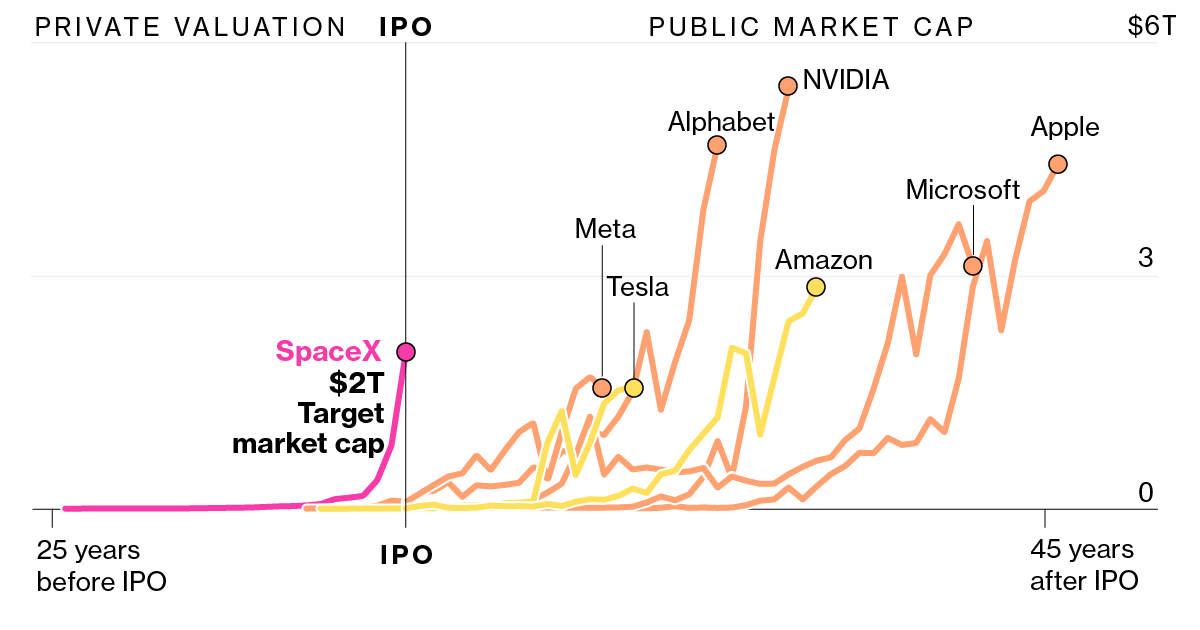
The Mega-Raise: The anticipated spacex ipo date and price framework points to a June 2026 roadshow, aiming to raise $75 billion at a staggering $1.75 trillion spacex valuation.
Liquidity Vacuum: Institutional funds are expected to rebalance risk-on portfolios, potentially triggering a localized sell-off in terrestrial, small-cap AI equities to free up capital.
Compute-in-Orbit: The integration of xAI (Grok) shifts SpaceX from a launch provider to an orbital AI data center, fundamentally changing the baseline for AI infrastructure valuations.
Index Squeeze: The sheer market cap weight of a newly listed SpaceX threatens to crowd out small-cap tech stocks from passive ETF inflows.
Strategic Entry: Rather than attempting to time the exact opening bell, strategic investors often watch for the historical "10-20 day pullback" pattern to build positions.
The impending SpaceX IPO acts as a short-term liquidity vacuum that poses a direct threat to small-cap AI stocks. As institutional capital prepares to absorb up to $75 billion in primary market allocation, funds will systematically liquidate tier-two AI and software equities to free up cash.
While this creates immediate downside volatility for terrestrial software startups, it simultaneously establishes a new "asset-heavy" benchmark that redefines how global data infrastructure is valued.
Will the $75 Billion IPO Create a "Liquidity Vacuum"?
When a historic mega-cap enters the public markets, institutional liquidity must be reallocated to absorb the massive share issuance. This reallocation mechanically drains capital away from speculative, smaller-market-cap assets.
The Capital Drain from Risk Assets
Market liquidity is a finite resource. To secure allocations in a generational offering, mutual funds, hedge funds, and aggressive retail traders must free up cash.
They typically achieve this by selling off peripheral risk assets. Consequently, small-cap AI hardware firms and crypto assets frequently experience a temporary but sharp sell-off as institutional "dry powder" is hoarded for the primary market.
The Attention Economy Shift
Financial markets run on sentiment as much as capital. The financial media dominance surrounding the June roadshow shifts retail focus entirely away from uncovering the "next big AI small-cap" to chasing the immediate aerospace hype.
This lack of daily trading volume can leave small-caps vulnerable to sudden price drops.
What Is the Influence of the SpaceX-xAI Merger?
The merger transitions SpaceX from a purely logistical aerospace company into a vertically integrated AI data network, bypassing the physical energy constraints that limit ground-based AI competitors.
Moving from Terrestrial Software to "Compute-in-Orbit"
Current AI models face a severe terrestrial bottleneck: the physical power grid and data center cooling capacities. By combining Starlink’s high-bandwidth satellite network with xAI’s processing capabilities, SpaceX introduces "Compute-in-Orbit." This utilizes unshielded solar energy and natural vacuum cooling, creating an infrastructure moat.
What the Merger Means for Terrestrial AI Startups
This massive infrastructure play makes traditional, software-only small-cap AI companies look less defensible to institutional analysts. If an investor can buy a single ticker that owns the AI model, the global internet pipeline, and the orbital servers, single-vertical AI startups struggle to justify high revenue multiples.
Terrestrial Small-Cap AI vs. SpaceX/xAI Infrastructure:
Factor | Terrestrial Small-Cap AI | SpaceX / xAI Infrastructure |
Capital Constraints | Highly dependent on continuous VC funding. | Supported by $20B+ Starlink recurring revenue. |
Energy Reliance | Bound by local terrestrial power grids. | Unrestricted solar access in Low Earth Orbit (LEO). |
Market Moat | Software algorithms (easily replicated). | Physical orbital networks and launch exclusivity. |
→ Click to learn: SpaceX’s Revenue Breakdown (Starlink vs. Launch vs. Grok)
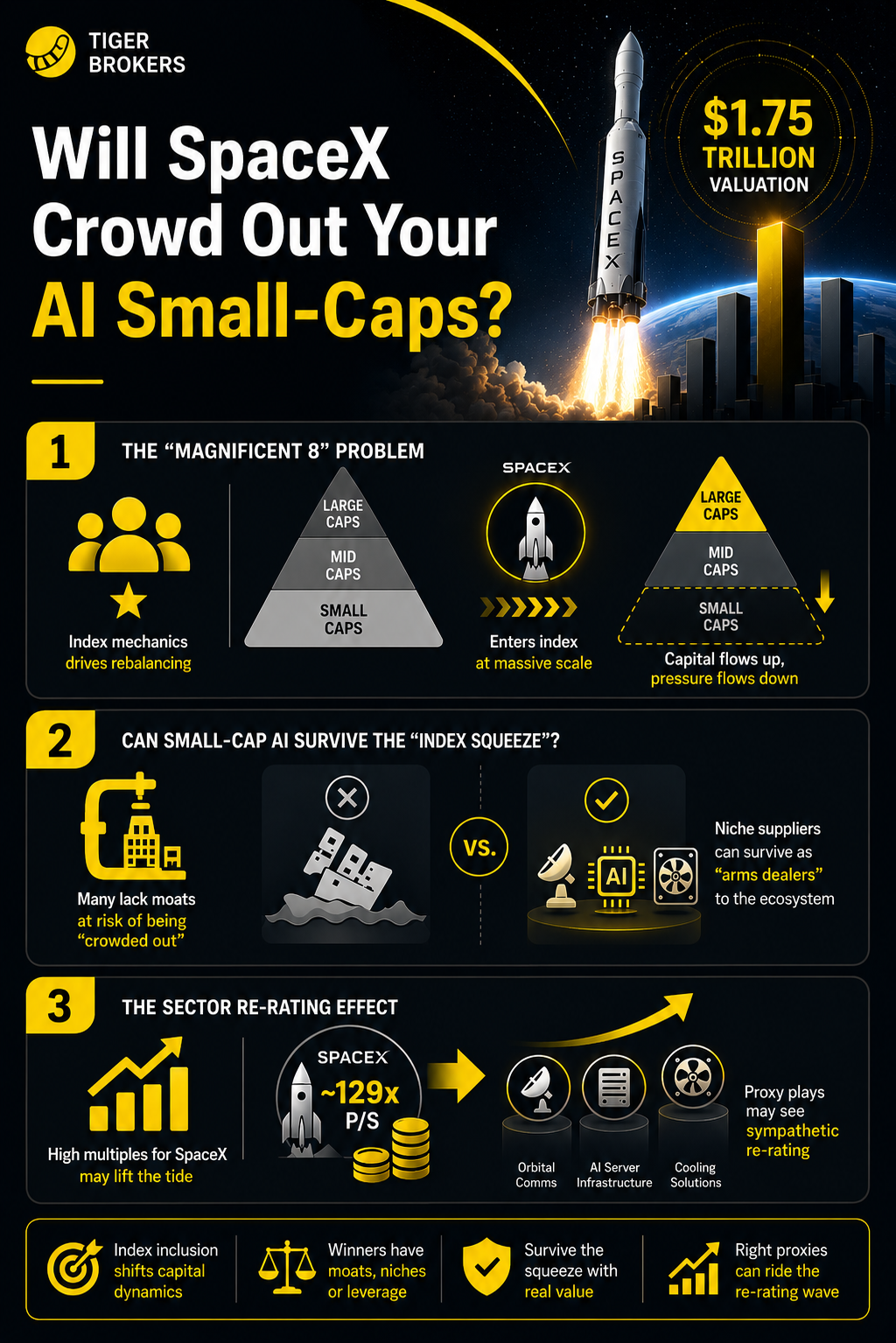
Will SpaceX Crowd Out Your AI Small-Caps?
There is a strong possibility. The introduction of a $1.75 trillion company into cap-weighted indices mechanically forces passive funds to reduce their holdings in the smallest index constituents to maintain balance.
1. The "Magnificent 8" Problem
Major indices like the S&P 500 or Nasdaq-100 are weighted by free-float market capitalization. When Vanguard or BlackRock index funds are compelled to buy SpaceX shares to match the new index weight, that capital is proportionally diverted away from the companies at the bottom of the index.
2. Can small-cap AI survive the "Index Squeeze"?
Companies lacking a proprietary moat risk being "crowded out" of major ETFs. However, firms that supply components or niche hardware to the broader aerospace and AI ecosystem may survive by acting as "arms dealers" to the larger movement.
3. The Sector Re-rating Effect
Conversely, if the market readily absorbs the spacex stock price prediction multiples (rumored at around 100 P/S), it may validate higher valuations for other asset-heavy infrastructure plays.
Proxy stocks, such as specialized orbital communications or niche AI server cooling firms, might see a sympathetic re-rating.
SpaceX IPO FAQ
1. Should I trim my small-cap AI positions before the June 8 roadshow?
Expect volatility. If your holdings lack a structural moat, institutional rotating capital may trigger a localized sell-off.
2. Does the SpaceX valuation signal an AI bubble?
Not necessarily. It signals a shift toward "Asset-Heavy AI", where physical infrastructure (rockets/satellites) validates the software valuation.
3. Is there any "Alpha" left in the secondary market after the IPO?
Watch for the "10-20 day pullback." Historically, mega-IPOs see a secondary market dip after the initial "pop," offering a better entry point.
Note: Market volatility surrounding IPOs presents high risks. Past performance in secondary market pullbacks does not dictate future results.
How to Prepare My SpaceX IPO Trading Strategy
If you are planning to utilize margin for upcoming public offerings, it is critical to note that maximum leverage for IPO subscriptions on platforms like Tiger Brokers is strictly capped at 10x. For those targeting high-priced tech leaders in the secondary market post-listing, having your capital positioned early is the most effective strategy.
Disclaimer: The information provided is for educational purposes only and does not constitute financial advice. Market conditions change rapidly, and individual financial situations vary. Past performance is not indicative of future results. Investment involves risk. Investors should read the relevant offering documents and consult with their own advisors before making investment decisions.
Reference
Reuters: Exculsive: SpaceX accelerates IPO timeline, targets June 12 listing on Nasdaq, sources say
Statt: How the SpaceX IPO Reshapes AI Capital and Global Competition
Institute of Business & Finance: BlackRock, Vanguard, State Street: The Big Three Explained
Investopedia: Market Proxy: Definition, Functionality, and Market Influence