TradingKey - On October 9 ET, AST SpaceMobile (ASTS) stock fell as much as 16% intraday, hitting its lowest level since October 2025.
The direct trigger for the stock decline was SpaceX (SPCX) announcing the acquisition of nationwide 800MHz low-band spectrum, with plans to integrate it with its Starlink satellite network to build an independent mobile carrier business.
This transaction is viewed by the market as a signal that SpaceX is officially entering the U.S. mobile telecommunications market. For AST SpaceMobile, the impact stems not only from a new competitor, but also from SpaceX changing the rules of competition in the direct-to-cell satellite industry.
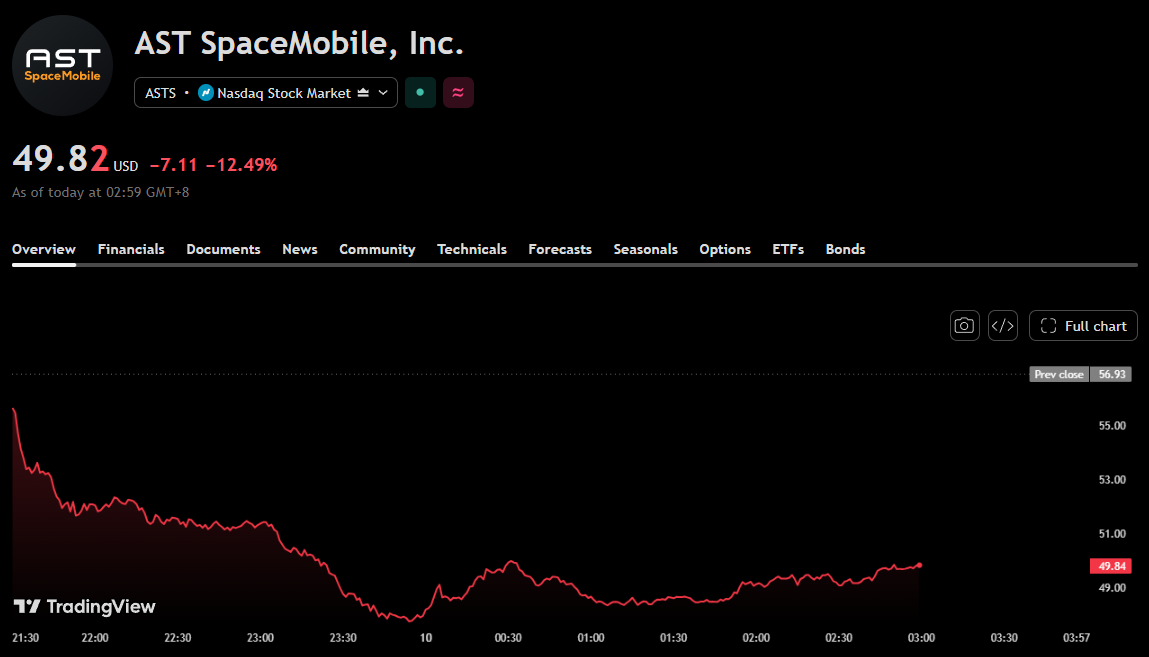
ASTS stock chart, Source: TradingView
SpaceX Enters the Same Market, Forming a Direct Substitution Relationship
AST SpaceMobile's business focus is using satellites to provide communication services to standard mobile phones, connecting users through partnerships with mobile operators.
SpaceX, meanwhile, plans to leverage Starlink satellites, 800 MHz low-frequency spectrum, and ground networks to offer mobile communication services independent of traditional operators. In the future, the two companies will compete for the same user communication needs, spectrum resources, enterprise clients, and regulatory attention.
The 800 MHz band offers strong signal penetration capabilities, which can improve indoor coverage and is compatible with most mobile devices. By incorporating it into the Starlink Mobile system, SpaceX can extend from satellite networks to more comprehensive mobile communication services.
Therefore, the reason driving the sell-off in AST SpaceMobile is that investors fear SpaceX is no longer just a satellite communication provider, but could become a direct competitor to AST SpaceMobile in the direct-to-cell market.
AST SpaceMobile's Advantage Eroded by SpaceX's Independent Path
AST SpaceMobile has long emphasized an "operator-friendly" business model, providing satellite services through partnerships with existing carriers. The advantage of this model lies in leveraging carriers' spectrum, customer relationships, and sales channels, thereby alleviating the pressure to build out a complete mobile network independently.
However, SpaceX has chosen to bypass traditional carriers, taking direct control of spectrum, satellite networks, and service access. If this model ultimately gains regulatory approval and achieves commercialization, AST SpaceMobile's original differentiated advantage could be weakened.
This does not mean the carrier partnership model has failed, but the market will re-evaluate its value: if major satellite operators can independently acquire spectrum and directly serve consumers, traditional carriers' status as "gatekeepers" in direct-to-cell services may decline, and AST SpaceMobile's bargaining power in negotiations with carriers could also be impacted.
Funding and Network Scale Gaps Amplify ASTS Valuation Pressure
AST SpaceMobile currently has only 13 satellites in orbit and still needs ongoing financing to complete its constellation buildout and commercial deployment.
By contrast, SpaceX boasts Starlink's existing launch system, satellite network, and user base. SpaceX reportedly holds approximately $93.52 billion in cash, while Starlink's user base has grown to around 12 million.
This means that SpaceX may have greater resilience, even if it adopts more aggressive pricing or incurs higher capital expenditures in the early stages of commercialization. Investors are therefore concerned that AST SpaceMobile, in competing for carriers and users, may need to increase spending on satellite deployment, network construction, and marketing, thereby driving up financing needs and potential equity dilution pressure.
With a significantly larger competitor, AST SpaceMobile's future revenue growth, service pricing, and profit margins all need to be reassessed, directly impacting its valuation.
Find out more