TradingKey - OpenAI said Wednesday that engineering samples of Jalapeno, the first custom chip co-developed with Broadcom (AVGO), have been delivered and are currently undergoing laboratory testing. Broadcom CEO Hock Tan said early results show that under typical AI workloads, Jalapeno's operating costs could be reduced by about 50% compared with common AI GPUs.
Jalapeno is primarily designed for large language model inference, the stage after model training when systems respond to user requests and execute tasks. Richard Ho, head of hardware at OpenAI, said the chip achieves a balance between throughput and response speed, allowing it to serve more users at a lower cost while reducing wait times for tasks with high real-time response requirements. The chip has a power rating of approximately 700 watts, which is expected to reduce data center electricity costs.
OpenAI said Jalapeno demonstrated high performance per watt in internal testing and outperformed Nvidia's existing products in some tests. However, these results remain early internal test disclosures that have not yet been validated by large-scale commercial deployment. The chip was not tested against Nvidia's latest-generation Vera Rubin, nor is it used for AI model training, so it will not replace Nvidia's products in the training space in the short term.
Following the news, Broadcom's stock rose more than 1% early in the session before narrowing its gain to 0.66%, trading at $361.13.
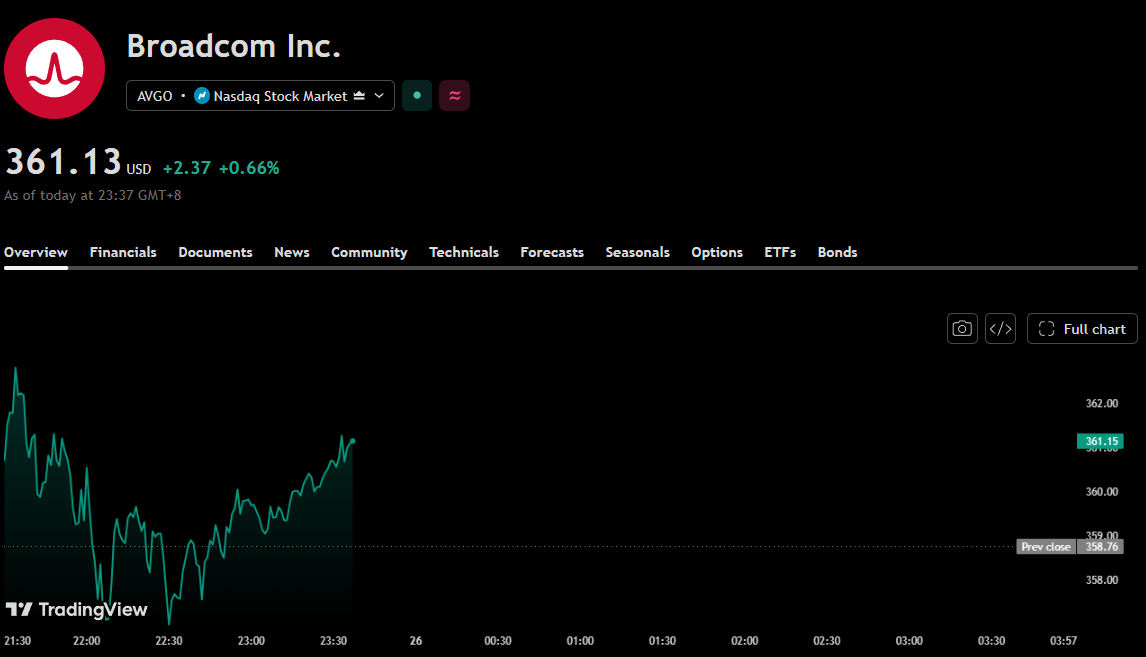
Broadcom stock price chart, Source: TradingView
According to the plan, the final version of Jalapeno will be deployed to data centers of Microsoft and other partners starting later this year. Broadcom previously expected to deploy approximately 1.3 gigawatts of the chips next year, and Tan said that as demand continues to grow, the actual scale may exceed that target. The two companies have also established a multi-generational chip roadmap, with the next-generation product expected to launch in 2028 and undergo continuous iterations thereafter.
This partnership is an important step for OpenAI to expand its chip supply sources and reduce infrastructure costs. In addition to continuing large-scale purchases of Nvidia products, OpenAI has also partnered with chipmakers such as AMD and Cerebras, and plans to strengthen control across chips, memory, networking, and data center systems. The company raised approximately $122 billion earlier this year to invest in chips, data centers, and talent. However, how OpenAI will pay for large-scale chip orders remains to be determined by subsequent financing arrangements.
Find out more