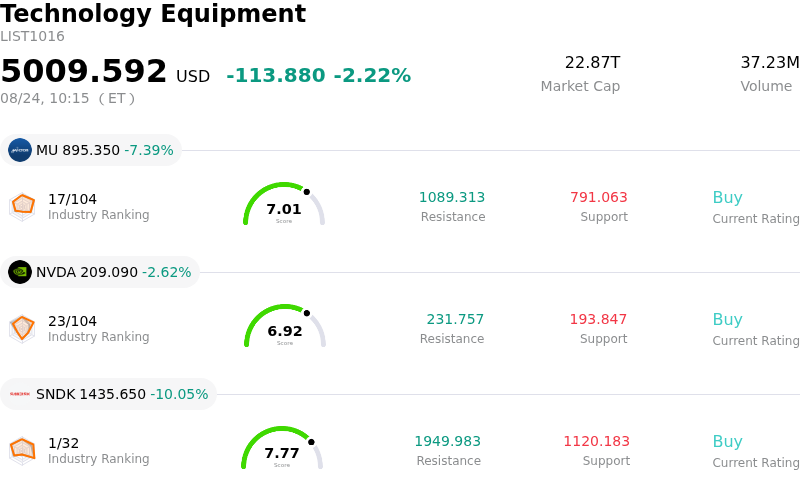
Taiwan Semiconductor Manufacturing Co Ltd (TSM) moved down by 3.11%. The Technology Equipment sector is down by 2.22%. The company underperformed the industry. Top 3 stocks by turnover in the sector: Micron Technology Inc (MU) down 7.61%; NVIDIA Corp (NVDA) down 2.68%; SanDisk Corporation (SNDK) down 10.05%.
What is driving Taiwan Semiconductor Manufacturing Co Ltd (TSM)’s stock price down today?
Taiwan Semiconductor Manufacturing Company experienced downward price pressure and heightened intraday volatility as market participants engaged in profit-taking following a substantial rally across the semiconductor sector. After months of sustained gains driven by robust artificial intelligence demand and strong operational performance, short-term sentiment cooled as institutional investors adjusted risk exposure and rebalanced tech-heavy portfolios.
From a fundamental and financial perspective, ongoing discussions surrounding capital intensity and valuation multiples contributed to the pullback. While the company maintains a commanding market share in advanced logic foundry manufacturing and continues to raise capital expenditure targets to expand leading-edge capacity, aggressive capital outlay plans can temporarily weigh on investor sentiment. Market participants frequently scrutinize heavy upfront investments due to potential near-term cash flow constraints and margin digestion, particularly when equity valuations trade at elevated premiums relative to historical averages.
Industry dynamics and macroeconomic factors further amplified the day's price swings. Although the company remains the primary manufacturing engine for global high-performance computing and AI accelerator designers, broader macroeconomic headwinds—including shifting interest rate expectations and sector-wide sentiment shifts—led investors to take a more cautious stance. Furthermore, persistent geopolitical considerations and the high costs associated with international foundry expansion continue to introduce periodic volatility into the stock. Overall, the pullback reflects a consolidation driven by valuation digestion and macro-driven sector rebalancing rather than a disruption in the company's core technological leadership.
Technical Analysis of Taiwan Semiconductor Manufacturing Co Ltd (TSM)
Technically, Taiwan Semiconductor Manufacturing Co Ltd (TSM) shows a MACD (12,26,9) value of -0.892, indicating a sell signal. The RSI at 43.978 suggests neutral condition and the Williams %R at 99.304 suggests oversold condition. Please monitor closely.
Fundamental Analysis of Taiwan Semiconductor Manufacturing Co Ltd (TSM)
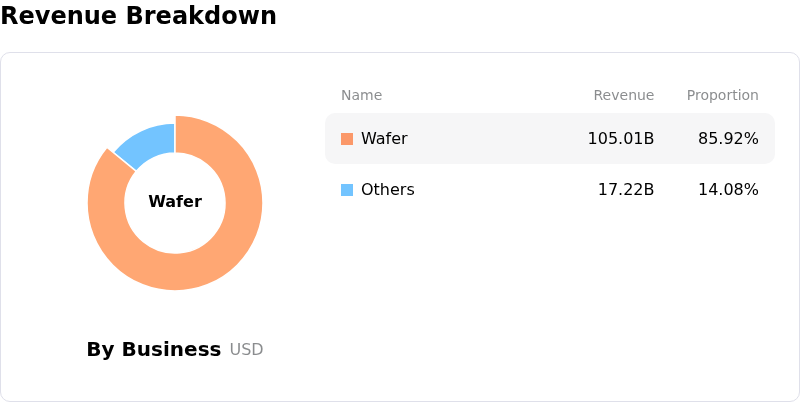
Taiwan Semiconductor Manufacturing Co Ltd (TSM) is in the Technology Equipment industry. Its latest annual revenue is $122.22B, ranking 2 in the industry. The net profit is $55.12B, ranking 2 in the industry. Company Profile
Over the past month, multiple analysts have rated the company as Buy, with an average price target of $542.64, a high of $700.00, and a low of $430.00.
More details about Taiwan Semiconductor Manufacturing Co Ltd (TSM)
Company Specific Risks:
- Surging Capital Expenditure and Margin Compression: TSMC's upward revision of its 2026 capital budget to $60–$64 billion—driven by massive outlays for 2nm node expansion and overseas fabs—has intensified institutional concerns regarding gross margin pressure, rising depreciation overhead, and potential return-on-investment dilution.
- Stretched Valuation Premia and Intraday Sensitivity: Intrinsic valuation models indicate TSM trades at a 22% to 27% premium relative to cash flow fair-value estimates, leaving the stock highly vulnerable to abrupt intraday profit-taking whenever broader AI sector momentum cools.
- Geopolitical Concentration and Trade Policy Vulnerabilities: Despite ongoing multi-billion-dollar investments in Arizona and Japan, TSMC remains heavily reliant on Taiwan for its primary manufacturing and leading-edge nodes, leaving operations exposed to cross-strait political risks and impending U.S. tariff policy discussions.
- Operational Complexity and Overseas Facilities Overhead: Rapid international expansion introduces heightened operational friction and unexpected costs, demonstrated by recent earthquake-related operational disruptions and disaster recovery outlays at its Kumamoto, Japan facility.
Find out more